Unmasking WordPress Temporal Side-Channel Attacks in Plugins
In the dynamic landscape of web security, understanding and mitigating advanced threats is paramount. A significant, yet often underestimated, area of concern for WordPress users and developers alike involves WordPress temporal side-channel attacks. These subtle vulnerabilities can expose sensitive information by analyzing the time it takes for a system to respond to different inputs. As we delve into 2026, the sophistication of these attacks continues to evolve, making in-depth analysis of WordPress plugins absolutely critical.
For a broader understanding of how plugins influence overall website behavior, consider how WordPress plugins dictate browser scripting and client-side logic in 2026. This interconnectedness often creates new avenues for such sophisticated attacks.
Understanding WordPress Temporal Side-Channel Attacks
WordPress temporal side-channel attacks exploit timing discrepancies in application execution. Instead of directly injecting malicious code or exploiting logical flaws, attackers observe the time taken for certain operations to complete. These minute differences, often measured in milliseconds or even microseconds, can reveal crucial information about the system's internal state, such as the validity of a username, the existence of a file, or the correctness of a password character-by-character.
These attacks are particularly insidious because they bypass traditional security measures like firewalls and input validation. The vulnerability isn't in the data itself, but in the processing of that data. For WordPress plugins, this often manifests in authentication routines, file access checks, or database queries where conditional logic can introduce timing variations. Understanding these timing vulnerabilities is crucial, much like understanding temporal drift and event sequencing vulnerabilities in WordPress plugins.
How Temporal Attacks Work in Practice
Consider a login form. If an invalid username takes 100ms to process, but a valid username followed by an incorrect password takes 200ms, an attacker can discern valid usernames. This forms the basis of many WordPress temporal side-channel attacks. The difference, however small, provides a probabilistic clue. Over many attempts, these probabilities coalesce into certainty.
- Authentication Timing: Password comparison functions that exit early on a mismatch can leak character validity.
- File Existence Checks: Operations checking for file existence might take longer if the file exists, revealing its presence.
- Database Queries: Variations in query execution time based on row existence or index usage can be exploited.
Identifying and Auditing Plugins for Temporal Vulnerabilities
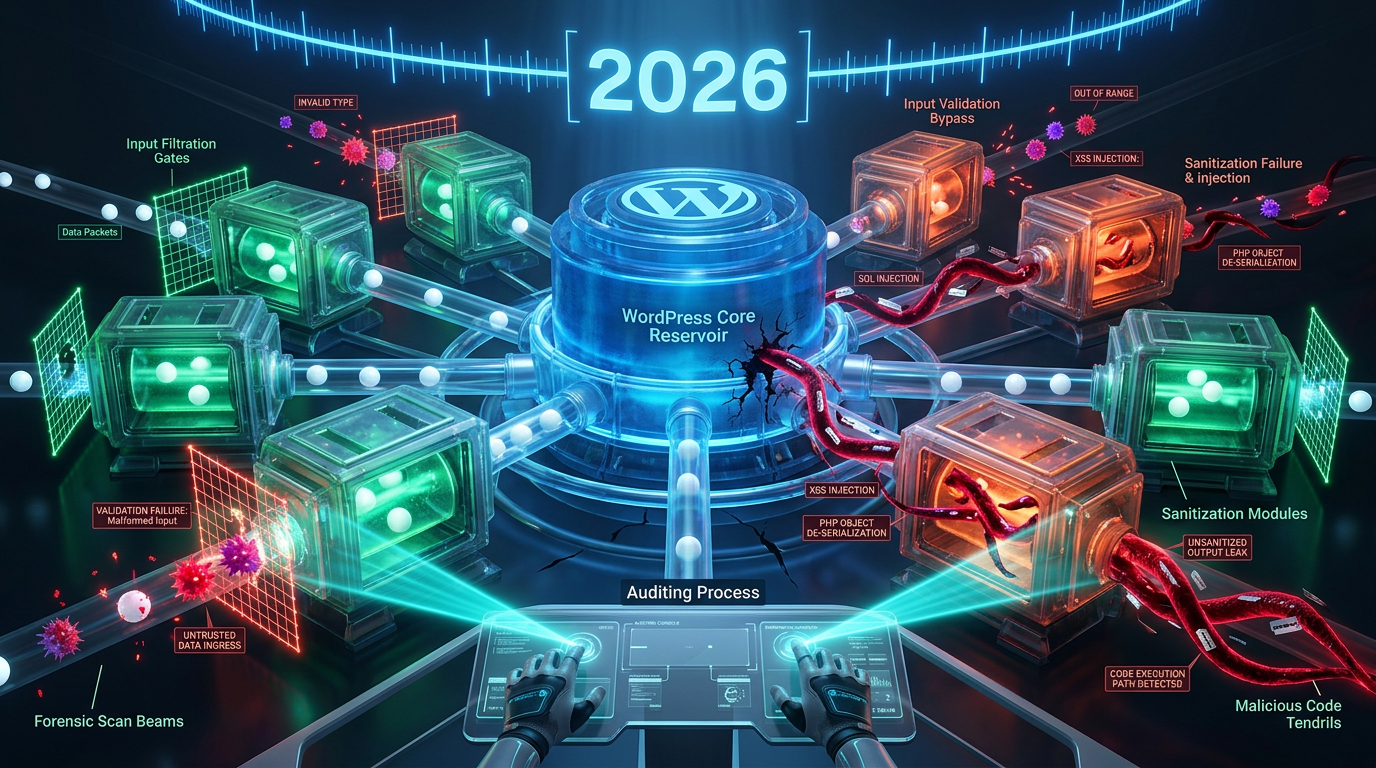
The project's deep dive into WordPress plugins places a strong emphasis on identifying these hidden threats. Given that WordPress temporal side-channel attacks are often subtle, manual code review alone can be insufficient. A multi-faceted approach combining static analysis, dynamic testing, and specialized timing analysis tools is essential in 2026.
When auditing plugins, we scrutinize critical sections of code that handle sensitive operations. These include authentication mechanisms, database interactions, file system access, and any place where conditional branching based on user input might lead to differential execution times. Outdated parsing libraries or custom-built comparison functions are frequent culprits. This careful scrutiny extends to how WordPress plugins redefine your site's digital fabric, as complex integrations can introduce new timing quirks.
Automated Tools for Detection
While full automation for detecting all temporal side channels remains a challenge, specialized security scanners are integrating more sophisticated timing analysis capabilities. These tools attempt to execute functions with varying inputs and measure execution times, flagging significant deviations. However, context is key; false positives are common, necessitating expert human review. Modern advances in quantum computing and its intersection with WordPress plugins in 2026 could potentially offer new, albeit complex, detection mechanisms in the future.
- Dedicated timing analysis frameworks.
- Advanced static application security testing (SAST) tools.
- Dynamic application security testing (DAST) tools with timing functions.
Manual Code Review Best Practices
For critical plugins, manual code review remains irreplaceable. Developers should pay close attention to string comparison functions, especially those handling passwords or API keys. Secure comparison functions, often called "constant-time" comparison functions, are designed to always take the same amount of time, regardless of whether characters match or not. Implementing these is a fundamental defense against WordPress temporal side-channel attacks.
Furthermore, any custom authentication or authorization logic within a plugin should be subjected to rigorous timing tests. Developers must consider that simple 'if-else' statements can introduce timing differences if the operations within each branch differ significantly in complexity or resource consumption.
Real-World Examples of WordPress Temporal Side-Channel Attacks in 2026
In 2026, we continue to see sophisticated exploits leveraging temporal vulnerabilities. A notable case involved a popular e-commerce WordPress plugin where a timing attack on its coupon code validation system allowed attackers to brute-force valid coupon codes. Customers observed slower responses for valid codes, which was imperceptible to the average user but became a significant attack vector when automated. This led to widespread fraudulent purchases and substantial financial losses for businesses using the plugin.
Another instance involved a membership plugin where specific database queries for user roles exhibited slight timing differences depending on the user's privilege level. Attackers, by repeatedly querying user profiles, could map out the privilege hierarchy of a site without any direct access to the database or admin panel. These examples underscore the insidious nature of WordPress temporal side-channel attacks and why detection is so critical for security-conscious website owners.
Case Study: Hacked CRM Plugin
Recently, a widely used WordPress CRM plugin fell victim to a temporal side-channel vulnerability. Its API key validation routine would return an "invalid key" message faster if the key was completely incorrect, but take slightly longer if the key had correct sections (e.g., correct length, but wrong characters). Attackers exploited this to systematically guess API keys, leading to unauthorized access to customer data. This highlighted the need for constant-time cryptographic operations, even for seemingly innocuous API key comparisons. This problem extends beyond simple keys to the broader issue of OWASP Top 10 vulnerabilities, where timing attacks are a growing concern.
Mitigating and Preventing WordPress Temporal Side-Channel Attacks
Preventing WordPress temporal side-channel attacks requires conscious effort from plugin developers and site administrators. The core principle revolves around ensuring that sensitive operations execute in "constant time," meaning their execution time does not depend on the specific values of the secret data being processed.
For developers, this means adopting secure coding practices, utilizing built-in WordPress functions designed for security, and carefully reviewing all conditional logic in security-critical paths. For administrators, keeping plugins updated and choosing reputable, well-audited plugins significantly reduces exposure.
Developer Best Practices
- Use Constant-Time Comparison Functions: For passwords, API keys, and other secrets, always use functions designed to take a fixed amount of time, such as
hash_equals()in PHP. - Minimize Conditional Branches in Sensitive Code: Refactor code to avoid branches whose execution time depends on secret data. Where branches are unavoidable, ensure both paths take approximately the same amount of time.
- Sanitize and Validate Input Early: While not a direct temporal attack defense, robust input validation can reduce the attack surface and prevent other forms of exploitation that might precede a timing attack. Essential reading on this topic can be found in PHP Manual's security data input handling guidelines.
- Regular Security Audits: Embed security reviews, including checks for timing vulnerabilities, into the plugin development lifecycle.
Administrator and User Safeguards in 2026
- Stay Updated: Regularly update all WordPress core, themes, and plugins to their latest versions. Developers frequently patch security vulnerabilities, including temporal ones.
- Choose Reputable Plugins: Opt for plugins with strong security track records, active development, and positive community reviews regarding security. This project aims to provide comprehensive reviews to aid in this decision. For guidance, platforms like WordPress.org Plugin Directory offer insights into plugin activity and reviews.
- Implement Web Application Firewalls (WAFs): While WAFs can't stop all temporal attacks, they can help mitigate the effects by throttling requests from suspicious IP addresses, making systematic timing attacks harder to execute.
- Monitor Logs: Keep an eye on access logs for unusual patterns, such as an excessive number of login attempts from a single IP, or repeated requests to specific API endpoints within a short timeframe.
The Future of Plugin Security and Temporal Attack Defense
As we move further into 2026, the landscape of plugin security is constantly evolving. The awareness of advanced threats like WordPress temporal side-channel attacks is growing, leading to more robust security implementations. The industry is seeing a push towards formal verification methods and automated static analysis tools that can better identify these subtle flaws.
Moreover, the emphasis on a "security-by-design" approach for WordPress plugin development is becoming standard. This means security considerations, including protection against temporal attacks, are integrated from the very beginning of the development process, rather than being an afterthought. This holistic approach, combined with ongoing research and education, will strengthen the WordPress ecosystem against these sophisticated attack vectors. This also ties into the broader implications of supply chain integrity in WordPress plugins in 2026.
Our project's commitment to in-depth analysis and comparative reviews will continue to arm WordPress users with the knowledge and best practices needed to navigate the complexities of plugin security in the modern web environment.
Frequently Asked Questions

Written by Aras Akıncılar
Uzun yıllara dayanan WordPress deneyimine sahip bir siber güvenlik uzmanı olarak, eklenti ekosisteminin derinlemesine analizine odaklanıyorum. Güvenlik açıkları, performans düşüşleri ve uyumluluk sorunları üzerine hazırladığım makalelerle, WordPress kullanıcılarının sitelerini daha güvenli ve verimli hale getirmelerine yardımcı olmayı hedefliyorum.